A Self-Service Kiosk Factory's DTC SEO Case: 9 Overseas Inquiries in 20 Days from Domain Registration
Bottom line: Starting from a brand-new domain, a Shenzhen kiosk factory received 9 real inquiries from 7 countries within 20 days, mostly OEM/ODM and project procurement. It shows that a B2B factory category can see search-driven inquiries early when site foundations, English content, and link building are all in place. But it is a single project's interim result, an inquiry is not an order, and it can't be applied directly to other industries.
Background
The client is a self-service kiosk manufacturer in Shenzhen, making kiosks for self-ordering, self-checkout, passport and hotel check-in, and visitor management, plus related readers, POS terminals, panel PCs, and signage. The factory has its own production and quality control, but it had no official website that overseas buyers could find through search.
Our goal was specific: when overseas buyers search Google for this kind of equipment, they should be able to find this factory and leave an inquiry. This falls under our DTC Google SEO business line, the second engine that runs alongside our short-video matrix. For how the two lines differ and when each fits, see our comparison of TikTok Shop and a DTC site.
Timeline
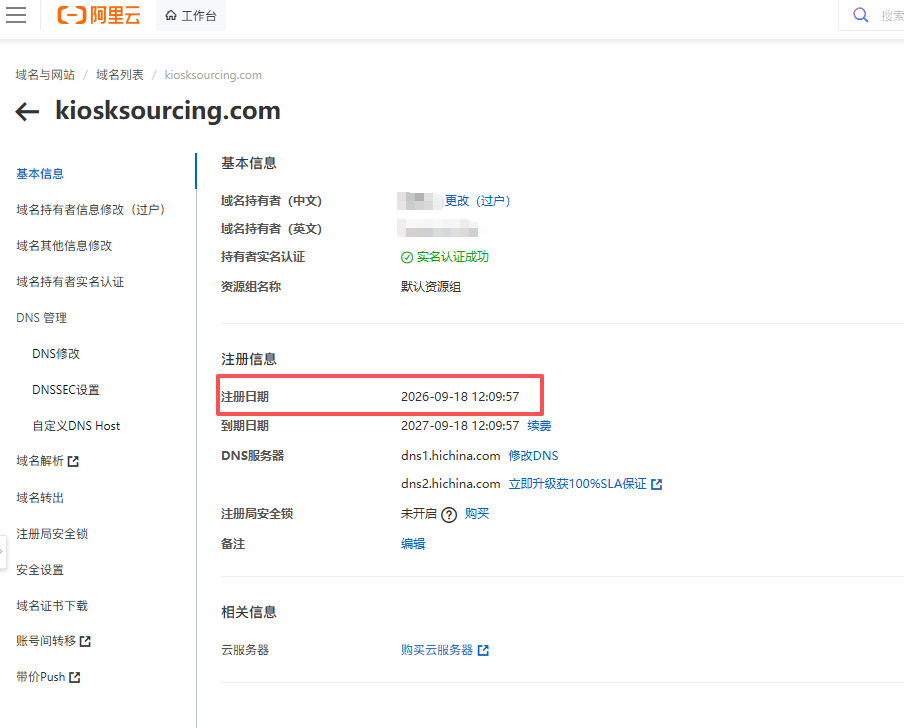
- Sep 18: a new domain, kiosksourcing.com, was registered, starting from zero with no history or authority;
- After that: a fully custom DTC site went live, with technical SEO, English content, and link building running in parallel;
- Oct 1: first inquiry arrived, from a government visitor-management project in Jordan;
- Oct 8: 9 inquiries in total, 20 days from domain registration to the ninth.
Inquiries came by email and WhatsApp. Client names and company details have been removed. Below is the domain registration record (owner details masked):
What the Inquiries Looked Like
The 9 inquiries came from 7 countries — Italy, Jordan, the United States, Norway, the United Kingdom, Brazil, and Malta — and were mostly OEM/ODM and project procurement requests rather than scattered individual buyers:
- Italy: branded touchscreen terminals for a tire-dealer network;
- Jordan: a tender for government visitor-management kiosks;
- New York, USA: a self-service personalization all-in-one machine for retail;
- Norway: a custom interactive kiosk, with a factory visit planned;
- UK: wall-mounted touchscreen all-in-one units, OEM/ODM;
- Brazil: a supermarket self-checkout sample, with private-label interest;
- Malta: a networked showroom touchscreen (contacted via WhatsApp).
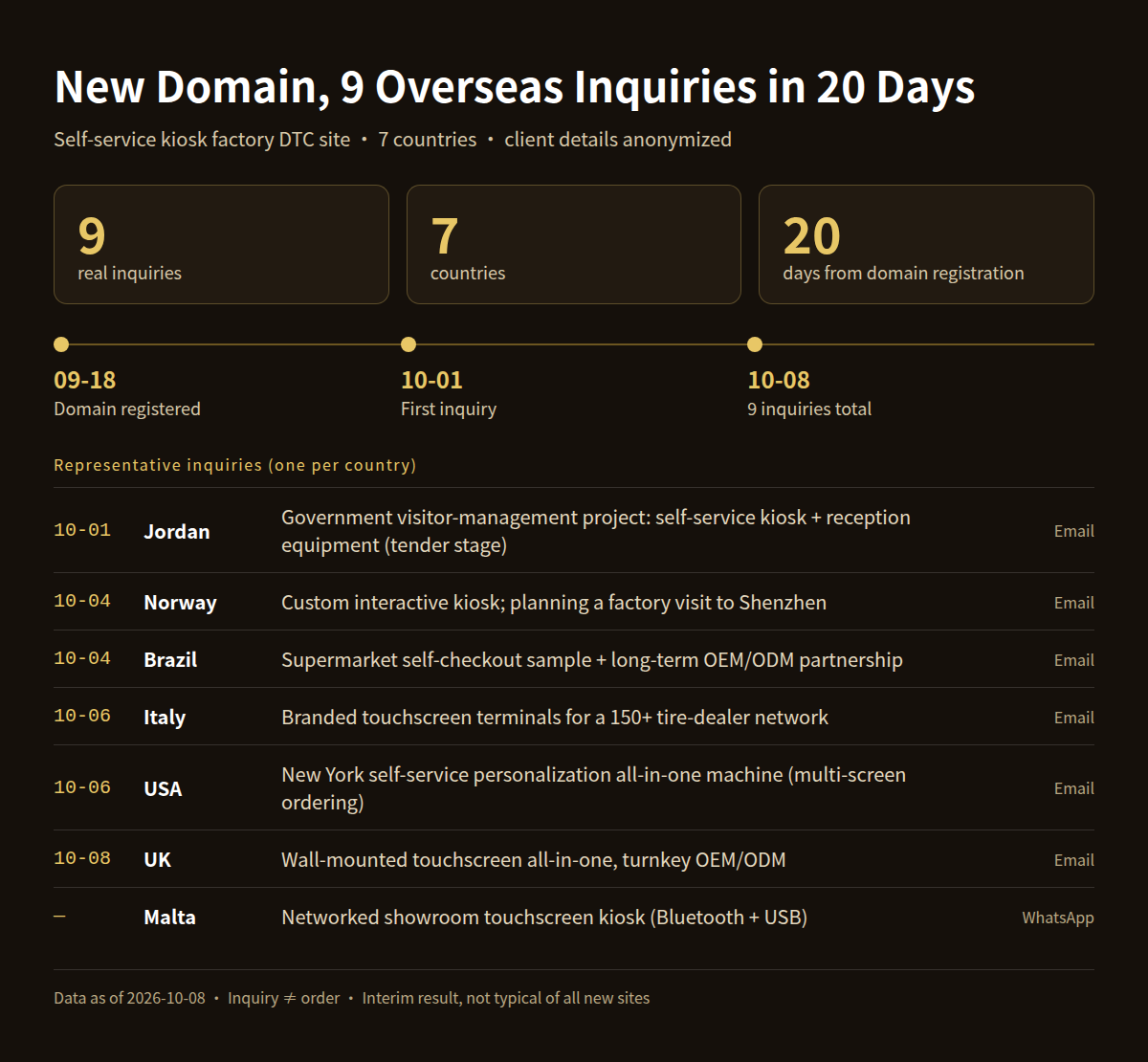
What they share: the buyers are already running projects and need a factory that can customize, supply samples, and be audited. That is the difference between B2B and consumer DTC conversion — B2B buyers look for evidence of factory strength and customization ability, not discounts.
What We Did
The work fell into four parts, mapping to the modules in our SEO service:
1. A fully custom DTC site. The site was organized around how B2B buyers browse: clear product categories, certifications, factory scale, and customization capability placed prominently, and a clear inquiry entry on every page. Site speed also had to be controlled from the start — see our article on DTC site speed optimization.
2. Technical SEO. Search Console was verified and submitted, sitemap and robots configured, page titles, descriptions, and tags handled, so that search engines could crawl and understand the site. You can self-audit against the checklist in our DTC SEO basics article.
3. English content. Pages and blog posts were written around the equipment and use cases buyers actually search for, rather than stuffing generic keywords.
4. Link building. Mostly white-hat, industry-relevant backlinks, while screening out spammy link risk.
What This Result Does Not Prove
This part matters more than the numbers, because a single case is easy to over-read.
An inquiry is not an order. Nine inquiries are sales leads. They still go through quotation, sampling, factory audit, and negotiation, and how many become orders depends on the factory's own pricing, delivery, and follow-up. For thinking on response time and communication boundaries, see our SOP for handling cross-border customer complaints.
20 days is not a normal SEO timeline. SEO is a medium-to-long-term program, and stable traffic growth typically takes 3 to 6 months. Inquiries arrived early here partly because of the category, the competitive environment, and the inquiry channels. It does not mean every new site will get inquiries in 20 days.
Results depend on industry competition and site foundations. Self-service kiosks are a fairly niche B2B category with clear search intent; a crowded mass-consumer category would move at a very different pace.
This is interim data. The results run through October 8, and their stability still needs to be watched.
Takeaways for Other Factories
If you're a B2B exporter, what's worth borrowing here is the method, not the numbers:
- Make the site findable early. The sooner the domain, site, and basic SEO are in place, the longer authority has to accumulate;
- Build content around buyers' procurement scenarios. Buyers search for "equipment type + use case + OEM," not your brand name;
- Put proof of factory strength on the site. Certifications, capacity, and customization examples are how B2B buyers judge reliability;
- Run social at the same time. Short video and SEO are two engines that reinforce each other — real factory footage can drive traffic to the site and add trust to it. See our article on building an account matrix.
Frequently Asked Questions
Can a new domain really get inquiries this fast? In this case, yes — but it is one project's result. Most new sites need 3 to 6 months before organic traffic growth is clearly visible, and the time to first inquiries varies widely by industry and site foundations.
Did these inquiries turn into orders? These are inquiry-stage figures. We make no commitments about closing. Conversion depends on the quotation, sampling, factory audit, and negotiation that follow.
How do I work with you on SEO? See our Services and Engagement Models page for the managed-service, mentorship, and dual-engine revenue-share models, or contact us directly for a tailored plan.
Final Thoughts
For a B2B factory, letting overseas buyers find you when they need you is the steadiest part of going global. If you'd like to assess which SEO path suits your own site and category, reach out to Dameng Global — we can offer specific recommendations based on your products and target market.